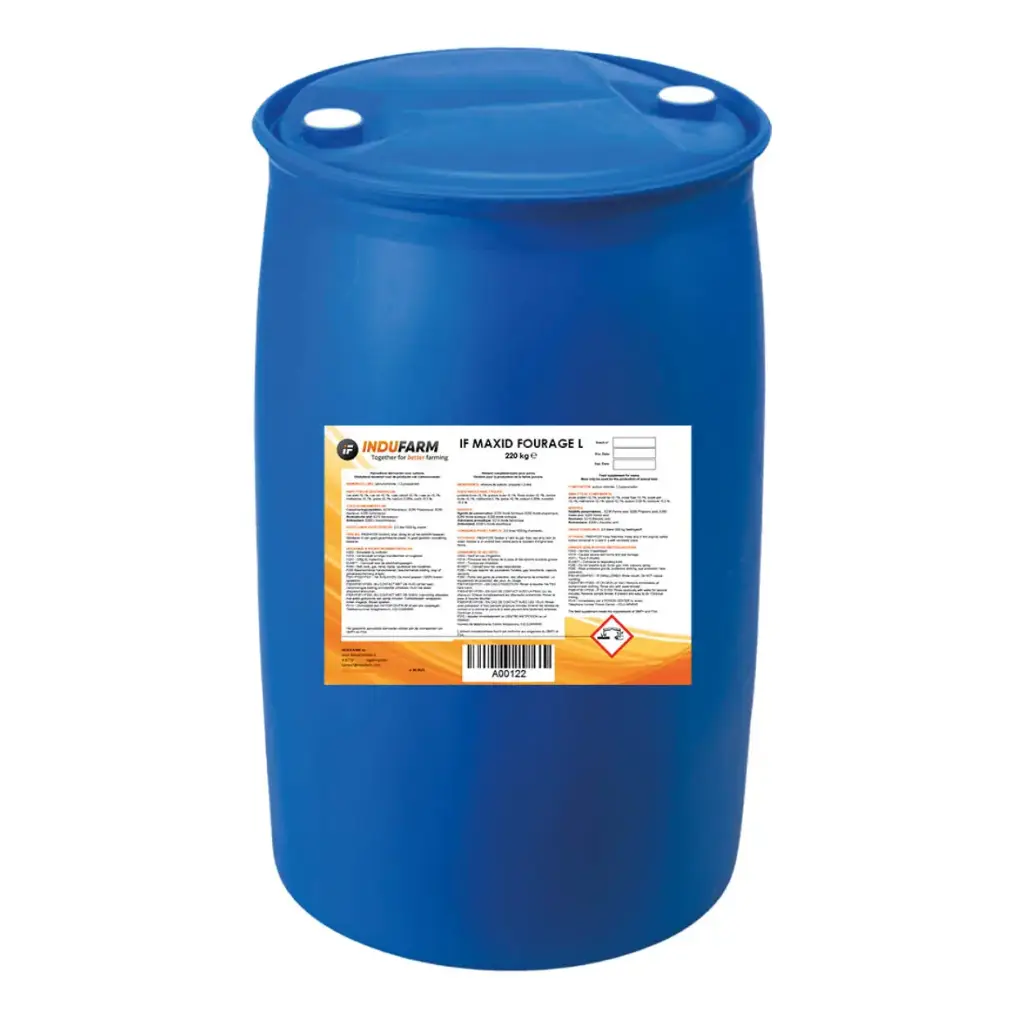
IF Maxid Fourage (TMR)
This product is produced in accordance with the FCA standard, interchangeable with GMP+. Sold feed will not be returned.
All‑in‑one broeiremmer voor stabieler kuil- én brijvoer
IF Maxid Fourage is een unieke voedingssupplement op basis van natriumchloride, 1,2‑propaandiol en organische zuren. Het ondersteunt een optimale conservering van kuilvoer en brijvoer . De combinatie van mierenzuur, propionzuur, benzoëzuur en sorbinezuur remt gisten, schimmels en ongewenste bacteriën. Hierdoor blijft het voer langer vers, met behoud van voedingswaarde en smakelijkheid.
Voordelen van IF Maxid Fourage (TMR) bij kuilvoer:
- Snelle pH‑daling: directe stabilisatie van de kuil.
- Remt broei en gisting: propionzuur voorkomt broei bij openen.
- Schimmelpreventie: sorbinezuur beschermt langdurig.
- Breedspectrumbescherming: benzoëzuur remt bacteriën en gisten, ook bij natte kuilen.
- Hogere opname: propionzuur levert extra energie en stimuleert voeropname.
- Praktisch en veilig: minder agressief dan puur mierenzuur.
Voordelen van Maxid Fourage (TMR) bij brijvoeding:
- Minder gisting en gasvorming: stabiele brij in leidingen, tanks en voerwagens.
- Broeipreventie: remt schimmel- en gistgroei, ook bij warme omstandigheden.
- Snelle stabilisatie: mierenzuur verlaagt direct de pH.
- Breedspectrumeffect: extra remming bij suiker- of zetmeelrijke mengsels.
- Praktisch in systemen : eenvoudig te doseren, minder agressief.
- All‑in‑one bescherming: werkt tegelijk tegen bacteriën, gisten en schimmels.
Dosering:
- Kuilvoer: 2 kg per ton
- Brijvoer: 3 tot 5 kg per ton
| Brand:: Indufarm |
Alternative Products
Your Dynamic Snippet will be displayed here...
This message is displayed because youy did not provide both a filter and a template to use.