At the end of October, an outbreak of highly pathogenic avian influenza (H5N1 type) was detected at a turkey farm near Diksmuide in West Flanders. The outbreak comes in the midst of a broader resurgence of avian influenza cases in Europe, prompting enhanced preventive measures, including in Belgium and the Netherlands. The Federal Agency for the Safety of the Food Chain (FASFC) in Belgium has therefore decided that all poultry must be kept indoors or in enclosed areas.
Avian influenza spreads rapidly via people, materials, vehicles and wild birds. An infection can have devastating consequences for your business — but with a well-developed biosecurity protocol, you can greatly reduce the risk. At Indufarm, we support poultry farmers with a practical and proven professional cleaning and disinfection protocol.
1. Biosafety: the first line of defence
Before we dive into cleaning and disinfection, it is crucial to adopt the correct biosafety framework:
- Limit visitors and traffic on the premises – and always register who enters and leaves.
- Install clear divisions between "dirty" and "clean" areas. Provide company-specific clothing and footwear.
- Provide disinfection mats, boot baths and replacement boots for each department at every stable entrance.
- Strengthen your biosafety protocols: it is advisable to focus extra attention on stricter controls, rigorous disinfection measures, and a closer look at the logistics chain.
- Keep wild birds and rodents out of the barn to limit the spread of disease, as they are known sources of infection.
- Keep a close eye on communications from the government (e.g. the FASFC) for any new zones or restrictions that may be put in place.
- If you suspect illness or sudden death in birds: report it immediately and take action (veterinarian, FASFC).
2. A thorough cleaning and disinfection protocol
In line with our poultry protocol (cleaning & disinfection), we methodically go through all the steps:
Step A – Cleaning: the basis for effective disinfection
1. Remove litter, manure, feathers, feed residues and organic material.
2. Pre-soak with lukewarm water (e.g. high pressure) to loosen dried-on dirt.
3. Alkaline foam cleaning with, for example, FullClean Foam Strong, to thoroughly remove grease, biofilm and manure residues.
4. Rinse with clean water and allow the stable to dry completely until no moisture spots are visible. This is essential, as a wet surface or organic residues reduce the effectiveness of any disinfectant.
👉 Tip: use the IF Applicator 1.0, 2.0 or 3.0 for even foam distribution.
Step B – Disinfecting: eliminating viruses
Once the stable has been cleaned and dried, disinfection can begin:
- First apply the disinfectant to all surfaces (floors, walls, equipment, transport materials), allowing sufficient contact time (usually 30 to 60 minutes).
- A rapid disinfection application works for walkways, boot baths and visitor areas.
Option 1: the basic disinfectant Force 7
- Dosage: 10 ml per litre of water (1%)
- Application: spraying or foaming (300 ml/m²)
- Contact time: 30 minutes at 10°C
- Use: rinse with potable water if contact with feed is possible
- Also applicable via thermal fogging for deep virus reduction before reoccupation.
Option 2: make it easy on yourself with broad-spectrum disinfection thanks to Prophyl S
Prophyl S deserves special attention because it has been developed specifically for intensive livestock biosecurity and is therefore an excellent fit within an avian influenza protocol.
- Prophyl S is the broadest spectrum disinfectant on the market — effective against bacteria, yeasts, moulds, mycobacteria, viruses and parasitic protozoa (such as oocysts) — and remains highly active even in the presence of organic matter.
- Virucidal effect with a 2% solution and 30 minutes exposure time at 10 °C
- Suitable for various applications: spraying, cold fogging (1 ml/m³), boot baths or disinfection mats, wheel baths and means of transport
- Disinfection that is not temperature-dependent (i.e. equally effective at lower temperatures, e.g. in winter)
- Highly recommended by veterinarians and Inagro
- Example of disinfecting hard surfaces: 2% solution → 300 to 500 ml/m², contact time 30 to 60 min., always rinse with drinking water after disinfection.
In short: Prophyl S meets the requirements for use in an avian influenza protocol because it is effective against avian influenza viruses, active at low temperatures and in the presence of organic material. It therefore perfectly supports the integrated approach for your stables.
Step C – Secure contact zones
- Place disinfectant mats or boot baths at entrances with disinfectant solution, e.g. Prophyl S.
- Change when visibly soiled or after the agreed time.
- Setting up walking routes: from outside to inside, only with clean boots in the stable.
- Ensure that mats remain sufficiently saturated at all times.
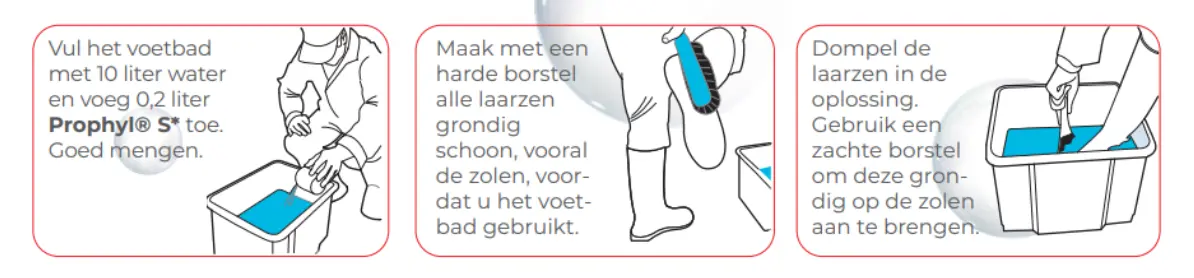
Protocol for boot baths
1. Use a 2% solution of Prophyl S (1:50), which is 2 litres for 100 litres of water.
2. Fill a foot bath with 10 to 15 litres of the solution to a minimum height of 10 cm.
3. Fill the immersion baths with the Prophyl S solution and place them at the entrance and transition of each building so that they are protected from adverse weather conditions.
4. Allow the solution to act for at least 1 minute at 10°C.
5. Change the solution once or twice a week, depending on the organic load of the solution.
Boot baths are an asset in preventing the introduction of disease
Disinfection mats
Ensure that the mats remain sufficiently saturated at all times.
3. A step-by-step plan for cleaning and disinfection
By following Indufarm's complete protocol, you can reduce the risk of sick animals to a strict minimum.
The cleaning and disinfection protocol against avian influenza is as follows:
- First remove coarse dirt, combat beetles, soak, and then clean with an alkaline cleaner such as IF FullClean Foam Strong + rinse + dry.
- Apply disinfectant and leave it to work for a sufficient amount of time:
- Prophyl S for surfaces, walls, floors, route zones
- Access gates/entrances: fill boot baths and disinfection mats with a Prophyl S solution. Clean boots or shoes beforehand, then immerse them.
- Means of transport (trolleys, crates): after cleaning, spray with Prophyl S, contact time if possible ≥ 5-10 min.
- Check & drying time: After applying Prophyl S, wait until all surfaces are dry before reoccupying or using the area again.
You can download the full protocol here: .
4. Working safely and quality control
Safety is essential when using biocides.
Always use the recommended protective equipment as specified in the protocol:
- Chemical-resistant boots and clothing
- The right quality of gloves in relation to the product used
- Safety goggles or full-face mask when spraying
Finally, check the end result: are all surfaces visibly clean, dry and odourless? Then the stable is ready for reoccupation.
5. Working together on prevention
A clean, dry and regularly disinfected barn is the best protection against avian influenza. By consistently following the Indufarm protocol and working with professional products such as FullClean Foam Strong, Force 7 and Prophyl S, you can drastically reduce the risk of introduction and spread. But beware: a well-designed protocol can only be effective if it is applied consistently. The use of walkway protection such as disinfection mats and boot baths, in combination with proper cleaning and disinfection, makes the difference between a high-risk environment and a safe barn.
Indufarm is ready to support you — both with products and tailored advice.
Together for better farming.