Good animal health starts with the basics: smooth digestion, a healthy gut, and high-quality feed and water. Acidification with organic acids has been a proven strategy for years. But not all acids are the same. Within the IF Maxid range, Indufarm offers various solutions, each with its own application and added value.
In this article, we explain in practical and clear terms the difference between the various products used to acidify either drinking water or mash feed. No unnecessary chemistry, but clear stable benefits, applications and guidelines for pigs, poultry and cattle.
Why acidify in the stable?
Acidifying drinking water, feed or roughage helps to:
- support digestion
- improve gut health
- creating an environment in which undesirable bacteria find it more difficult to thrive
- stimulate feed and water intake
- to limit losses due to heating, fermentation and mould
Depending on the animal, the type of water or feed, and the purpose in the barn, you can choose a different solution from the IF Maxid range.
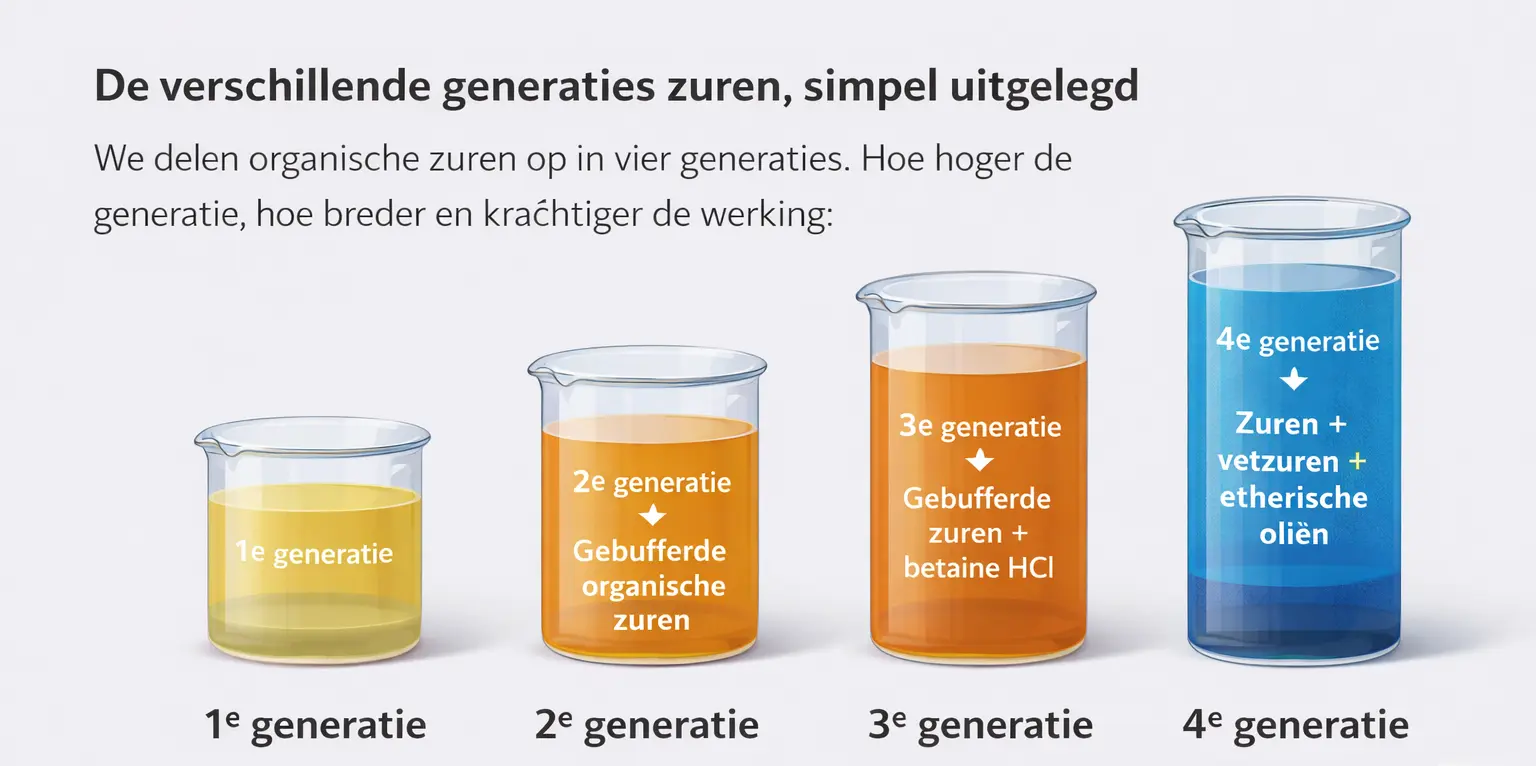
The different generations of acids, explained simply
We divide organic acids into four generations. The higher the generation, the broader and more powerful the effect:
- 1st generation: simple organic acids (rarely used in practice)
- 2nd generation: buffered organic acids → basic acidification
- 3rd generation: buffered acids + betaine HCl → extra support for the stomach and intestines
- 4th generation: acids + fatty acids + essential oils → maximum intestinal support and hygiene
IF Maxid products for drinking water: which of the 7 best suits your situation?
1. IF Maxid pH – basic acidification of drinking water
When should you choose IF Maxid pH?
For light to normally buffered water, when you mainly want to support water quality and digestion.
Benefits in the stable:
- Lower pH of drinking water
- Reduced growth of unwanted bacteria
- Better protein and mineral utilisation
- Higher water intake in your animals
Applications:
- Weaned piglets, fattening pigs, sows and poultry
- Ideal as a daily basic solution
2. IF Maxid Digest – extra digestive support
What is the difference with IF Maxid pH?
In addition to organic acids, Maxid Digest also contains betaine HCl, which provides extra support for stomach function.
Benefits in the stable:
- Improved stomach acidification in young animals
- Support for weaning stress
- Better feed conversion
- Stronger intestinal resistance
Applications:
- Weaning piglets
- Fattening pigs, sows in farrowing pens and poultry under digestive stress
Dosage:
1–2 litres per cubic metre of drinking water (depending on water quality)

3. IF Maxid Digest Forte – digestive aid for highly buffered water
When should IF Maxid Digest Forte be taken?
For hard or strongly buffered water, take IF Maxid Digest Forte because, in addition to the benefits of IF Maxid Digest, you will also achieve a significant pH reduction, resulting in a lower required dosage.
Benefits in the stable:
- More powerful acidification
- Supporting growth and feed conversion
👉 Important!
Water analysis and titration are essential for this product. Our advisors will guide you through the entire process.
4. IF Maxid Organic – biologic and flexible
Specially developed for organic livestock farming or businesses seeking a broader but milder acidification strategy.
Benefits in the stable:
- Organically deployable
- Supports digestion and gut health
- Widely applicable for pigs and poultry
Dosage:
1–2 litres per cubic metre of drinking water
5. IF Prevacide – via vet, targeted use
IF Prevacide is similar to IF Maxid Digest, but was developed in collaboration with veterinarians and is distributed exclusively through them. IF Prevacide is a drinking water acidifier based on organic acids, combined with betaine HCl, copper and zinc.
When to use?
• For specific health strategies
• In guidance programmes with the vet
Benefits in the stable:
- IF Prevacide aids digestion,
- helps stabilise gut health,
- and reduces the pressure of unwanted bacteria in the gastrointestinal tract
Applications:
- For weaned piglets:
- Supports stomach acidity → higher pepsin activity and better protein digestion
- Promotes villus development → better feed utilisation and growth
- Helps maintain stability during weaning stress
- For fattening pigs and poultry:
- Inhibits pathogens such as Salmonella and E. coli by lowering pH and antimicrobial acid action
- Improves utilisation of protein and amino acids
- Increases mineral absorption (thanks to improved intestinal conditions, among other things)
- For sows:
- Higher drinking water intake → often increased feed intake and support for milk production
Why betaine HCl provides added value
Betaine HCl is known as a component that supports extra stomach acidification, improving protein digestion and nutrient absorption — exactly the effect you want to enhance in weaning and digestion pressure.
Dosage:
1–2 litres per m³ of drinking water (depending on the buffering capacity of the water/water quality)
6. IF Maxid Nutrition Pro – maximal gut support
6. IF Maxid Nutrition Pro (4th generation)
What makes this product different?
In addition to organic acids, this product also contains short- and medium-chain fatty acids and essential oils.
Benefits in the stable:
- Strong support for the intestinal wall
- Help with infection pressure
- Better performance with less feed consumption
- The best protection for the intestines in cases of, for example, weaning diarrhoea
Applications:
- Weaning piglets
- Fattening pigs
- Poultry with wet litter or disturbed digestion
7. IF Maxid Nutrition Pro Forte – gut support with difficult water
The Forte variant is intended for strongly buffered water and has the same broad effect in terms of intestinal health, etc., but results in a greater reduction in pH.
Together, we will select the appropriate product and dosage based on your water analysis.
7. Maxid products for feed and roughage
7.1 IF Maxid Fourage – hygiëne in brijvoer
Why is it necessary?
Mash feed is susceptible to fermentation and mould, which leads to:
- loss of dry matter
- poorer palatability
- technical problems in pipes
Advantages of acidifying mash feed:
- inhibits yeasts and moulds
- retains nutritional value
- more stable mash feed
Dosage:
3–5 kg per tonne of wet feed
7.2 IF Maxid Silage – fris ruwvoer, meer opname
For cattle
IF Maxid Silage prevents heating and mould in silage and in the cut layer.
Benefits in the stable:
- Less loss of dry matter
- Improved palatability
- Increased feed intake
- In practice: often +1 litre of milk per cow per day
Applications:
- In the feed mixer
- On the cutting layer
Dosage:
- Winter: T<20°C 1 to 2 litres per tonne of feed mixture
- Summer: T>20°C 3 to 4 litres per tonne of feed mixture
What is dry matter loss?
Dry matter (DM) is everything in the feed except water: energy, protein, fibre, starch, minerals. When there is a loss of dry matter, also known as DM loss, the feed loses its actual nutritional value, even though the amount of feed may appear to be the same.
How does DS loss occur? Mainly due to:
- Heating (warming by oxygen)
- Fermentation by yeasts and bacteria
- Mould growth
These micro-organisms essentially consume the most digestible parts of the feed first.
What does DS loss mean in the barn?
DS loss leads to:
- 🔻 Lower energy and protein content
- 🐄 Reduced feed intake (feed becomes less palatable)
- 📉 Lower performance (growth, milk production, feed conversion)
- 💸 Invisible economic loss
👉 Specific example:
If silage loses 10–20% DM due to heating, you are paying for the feed, but literally feeding part of it away.
Why is this important for roughage and mash feed?
- With silage, DM loss can amount to 15–20% per week in the cut layer during heating.
- With mash feed, the dry matter can decrease daily due to fermentation.
That is why Indufarm focuses on limiting DM loss with IF Maxid Silage and IF Maxid Fourage, so that:
- the nutritional value is preserved,
- the feed remains fresh and tasty,
- performance in the barn remains stable.
Working together to find the right solution
Every stable is different. Water quality, animal species, age and management determine which solution is most suitable. That is why our service does not stop at the product.
At Indufarm, you get:
- practical advice
- water analysis and titration
- tailored guidance
- single point of contact for food, water and hygiene
👉 Not sure which type of acidification is best for your situation?
Please feel free to contact our advisers, and they will assess the situation on site together with you.
Together for better farming.